Friday, March 29, 2013

India

"Discrimination: Expectant mothers carrying girls are less likely to give birth in hospital, take iron supplements and receive tetanus immunisation,"
Indian Women Are Victims of Discrimination before They Are Even Born as Baby Boys Get Better Medical Treatment before Birth
By Olivia Williams
The Daily Mail, March 28, 2013
"A survey of more than 30,000 Indians by Michigan State University and University of California has revealed that preferential treatment for men starts before they are even born. Women expecting boys were more likely to get prenatal medical appointments, take iron supplements, and receive vital tetanus shots. They were also more likely to deliver a son in a health-care facility, as opposed to at home. It is even still common practice to have an abortion based on the baby's sex in India, though it is illegal. When baby girls are carried to full term, they still face medical discrimination with serious long-term health consequences. Assistant professor Leah Lakdawala from MSU who carried out the research said: 'This type of discrimination, while not as severe as sex-selective abortion, is very important for children's well-being' Missing out on the Tetanus vaccinations is a particular worry as it is the main cause of newborn deaths in India. Babies whose mothers had not received a tetanus vaccination were more likely to be born underweight or die shortly after birth. The researchers compared the survey to other patriarchal nations such as China, Bangladesh and Pakistan and saw similar evidence of medical discrimination. This could mean that girls are already at a serious disadvantage when they are born. 'We know that children born at higher birth weights go to school for longer periods and have higher wages as adults, so the future implications here are serious,' Lakdawala said.
The study was published in the Journal of Human Resources."
[n.b. This is the complete text of the dispatch. Thanks to Jo Jones for bringing this source to my attention.]

Monday, March 11, 2013

Syria

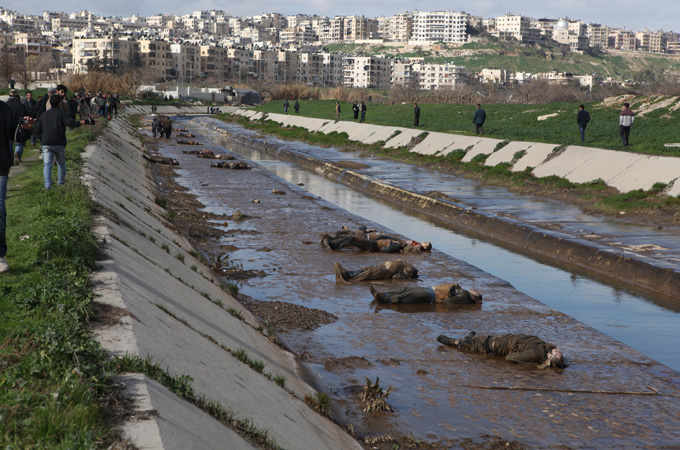
"Bodies revealed by the Queiq river's receding waters." (Thomas Rassloff/EPA)
Syria: The Story behind One of the Most Shocking Images of the War
By Martin Chulov
The Guardian, March 11, 2013
"It is already one of the defining images of the Syrian civil war: a line of bodies at neatly spaced intervals lying on a river bed in the heart of Syria’s second city Aleppo. All 110 victims have been shot in the head, their hands bound with plastic ties behind their back. Their brutal execution only became apparent when the winter high waters of the Queiq river, which courses through the no man’s land between the opposition-held east of the city and the regime-held west, subsided in January. It's a picture that raises so many questions: who were these men? How did they die? Why? What does their story tell us about the wretched disintegration of Syria? A Guardian investigation has established a grisly narrative behind the worst -- and most visible -- massacre to have taken place here. All the men were from neighbourhoods in the eastern rebel-held part of Aleppo. Most were men of working age. Many disappeared at regime checkpoints. They may not be the last to be found. Locals have since dropped a grate from a bridge, directly over an eddy in the river. Corpses were still arriving 10 days after the original discovery on January 29, washed downstream by currents flushed by winter rains. Just after dawn on 29 January, a car pulled up outside a school being used as a rebel base in the Aleppo suburb of Bustan al-Qasr with news of the massacre. Since then a painstaking task to identify the victims and establish how they died has been inching forwards. The victims, many without names, were mostly buried within three days -- 48 hours longer than social custom dictates, to allow for their families to claim them. Ever since, relatives have been arriving to identify the dead from photographs taken by the rescuers.

Friday, March 8, 2013

Female Infanticide / India

A Fight to Save Baby Girls in India
By Kamala Thiagarajan
The New York Times, March 7, 2013
"Back in the 1980s, this rural patch of the southern state of Tamil Nadu had the dubious distinction of the worst reputation for 'gendercide,' or murder of unwanted baby girls, in India. There were no official statistics, of course. Just as no one keeps a tally of how middle-class Indians today use scans to determine a baby's sex and whether to abort a female fetus, the child deaths in the Usilampatti region, home to about 85,000 people, were whispered about, not totaled. Often, births were unregistered, conducted by a village midwife who would then also kill unwanted girls. This was done quite openly -- and prompted Valli Annamalai, head of the Mother and Child Welfare Project, an initiative of the Tamil Nadu state branch of the nongovernmental Indian Council for Child Welfare, to act. She started by trying to grasp the size of the problem. Council statistics suggest that, in 1990, there were as many as 200 unaccounted-for infant deaths, all of girls, in this region. 'Girls were considered a burden and a liability in these parts,' she recalled during a recent visit to a council center in the village of Pannaipatti. Raising economic prospects 'was the only way to stop the mindless violence and discrimination.' One way to improve women's lot, she said, was to care for infants and thus allow mothers to return to their work -- mostly toil in the fields of this spottily fertile region, where women have been second-class for centuries.

Friday, February 8, 2013

Rape in the Military: An Open Letter to Kirby Dick

February 7, 2013

Dear Mr. Dick,

As a longtime advocate for victims of sexual abuse and editor of a forthcoming book titled The Rape of Males in War and Genocide, I am writing to express my great concern over the apparent content of your film The Invisible War (which I have not yet seen), and the marketing and publicity campaign surrounding it.

You are aware that in absolute terms, more men than women are sexually assaulted each year in the U.S. military. As reported on MSNBC.com, two of the male rape survivors interviewed for your film have accused you of marginalizing male victims by devoting less than five minutes of your documentary to their plight.

Moreover, according to the MSNBC.com report, "The publicity campaign hawking the film -- and its Academy Award candidacy -- includes a website that shows the faces of six female victims of military sexual assault, and no male survivors of that crime, as well as formal screenings to which only female victims have been asked to attend." I find this extraordinary and frankly outrageous. It is a real slap in the face to thousands of victims, declared or hidden, who already confront enormous obstacles, as male victims of rape and sexual assault, to getting a hearing and redress. Your justification for "invisibilizing" these male victims -- that "We kind of felt women would get the discussion going and push the military to make the change for everyone" -- is truly lame. The reality is that you have chosen the easy path of generating concern and sympathy for female victims of sexual assault, and have deliberately avoided devoting meaningful attention to the inconvenient majority of victims.

Thursday, February 7, 2013

Witch-Hunts / Papua New Guinea


Woman Burned Alive for "Sorcery" in Papua New Guinea
BBC Online, February 7, 2013
"A woman has been tortured and burned alive in Papua New Guinea after being accused of using sorcery to kill a young boy, local media report. The woman, a mother aged 20 named as Kepari Leniata, was stripped, tied up and doused in petrol by the boy's relatives in Mount Hagen in the Western Highlands, said the National newspaper. She was then thrown onto a fire in front of hundreds of people. Police and firefighters were unable to intervene, the paper said. The Post Courier newspaper said they had been outnumbered by the crowd and chased away. Both newspapers published graphic photos of the incident on their front pages. Provincial police commander Supt. Kaiglo Ambane told the National that police were treating the case as murder and would arrest those responsible. In parts of the Pacific nation deaths and mysterious illnesses are sometimes blamed on suspected sorcerers. Several reports have emerged in recent years of accused people, usually women, being killed. In 2009, after a string of such killings, the chairman of PNG's Constitutional Review and Law Reform Commission said defendants were using accusations of witchcraft as an excuse to kill people, and called for tougher legislation to tackle the issue. Local Christian bishop David Piso told the National that sorcery-related killings were a growing problem, and urged the government to 'to come up with a law to stop such practice'. The US embassy in the capital, Port Moresby, condemned the killing as a 'brutal murder', the AFP news agency reports, and evidence of 'pervasive gender-based violence' in Papua New Guinea."
[n.b. This is the complete text of the dispatch.]

Tuesday, January 29, 2013

Syria

"Free Syrian Army fighters say they are still recovering bodies at the river, where several people were found dead." (EPA)
Aleppo Executions: 65 Bodies Pulled from Syria River
The Telegraph, January 29, 2013
"The bodies of at least 65 young men and boys, all executed with a single gunshot to the head or neck, were found on Tuesday in a river in the Syrian city of Aleppo, a watchdog and rebels said. The Syrian Observatory for Human Rights said 65 bodies were found in the Quweiq River, which separates the Bustan al-Qasr district from Ansari in the southwest of the city, but that the toll could rise significantly. A Free Syrian Army officer at the scene said at least 68 bodies had been recovered and that many more were still being dragged from the water, in a rebel-held area. 'Until now we have recovered 68 bodies, some of them just teens,' said Captain Abu Sada, adding that all of them had been 'executed by the regime.' 'But there must be more than 100. There are still many in the water, and we are trying to recover them.' A senior government security source said many of the victims were from Bustan al-Qasr and had been reported kidnapped earlier. He accused 'terrorists,' the standard regime term for people fighting to overthrow President Bashar al-Assad, of carrying out the executions and spreading propaganda to deflect responsibility. 'They were kidnapped by terrorist groups, who some are accusing of being pro-regime, and executed last night in a park in Bustan al-Qasr under their control,' the source told news agency Agence France-Presse by telephone. ... A volunteer said as he helped load one of the bodies on a truck: 'We don't know who they are because there was no ID on them.' At least 15 bodies could already be seen on the truck, an AFP correspondent said, with other continuing to arrive.

Sunday, January 20, 2013

Serial Killings of Women / Canada

Serial killer William Pickton
How the Horrific Case of Serial Killer William Pickton, Who May Have Killed Up to 50 Women, Shone Light on Plight of Vancouver's First Nation Women
By David Usborne
The Independent, January 18, 2013
"Women vanish from Vancouver’s grimy Downtown Eastside with numbing regularity. But the fact a disproportionate number are of First Nations origin has plunged Canada into a political crisis. Ernie Crey, an aboriginal Canadian, is angry. It is twelve years since his sister, Dawn, vanished from Vancouver's downtown eastside -- an utterly dismal skid row of slum hotels, pimps, prostitutes, drug addicts, pushers and charities that try to help them -- and nine years since he learned that her DNA had been drawn from a pair of bloody women's knickers on the pig farm of convicted serial-killer William Pickton. It is worse when you have nothing to bury. Remains from the some victims were found at the farm, 40 minutes outside the city, and given to the families, including cleaved skulls. But nothing of Dawn was recovered. Mr. Crey might have ignored the stories of Pickton mincing human flesh with pork meat and selling it to neighbours, or having the victims' bones boiled down for pet food, but he didn't. 'I have gone there, yes, thought about it,' he admits quietly. 'Not knowing what really happened to her bothers me the most,' says Mr. Crey, 63, a member of the Cheam First Nation and a fisheries advisor to the Stolo Tribal Council. 'Barring Pickton coming forward and saying that yes, he was the asshole who killed her and the other women I don't think I will ever know'. But Mr. Crey is not despairing, in part because the pig-farm murders have not faded from the headlines. Though Pickton was convicted of the second-degree murder of six women in 2007 (the true number of his victims may have been closer to fifty or even higher), and he is now serving life in a federal prison with no chance of parole for 25 years, the case continues to shed light on Canada's most shameful secret: how its most ignored underclass -- indigenous women -- is preyed upon by men with impunity, and with terrifying consequences.