Tuesday, January 29, 2013

Syria

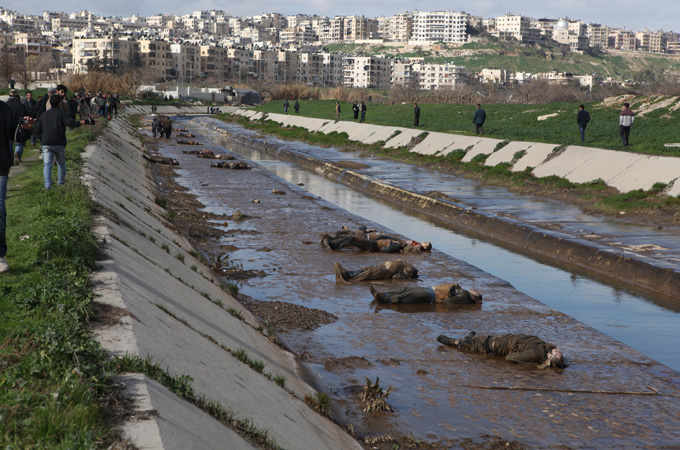
"Free Syrian Army fighters say they are still recovering bodies at the river, where several people were found dead." (EPA)
Aleppo Executions: 65 Bodies Pulled from Syria River
The Telegraph, January 29, 2013
"The bodies of at least 65 young men and boys, all executed with a single gunshot to the head or neck, were found on Tuesday in a river in the Syrian city of Aleppo, a watchdog and rebels said. The Syrian Observatory for Human Rights said 65 bodies were found in the Quweiq River, which separates the Bustan al-Qasr district from Ansari in the southwest of the city, but that the toll could rise significantly. A Free Syrian Army officer at the scene said at least 68 bodies had been recovered and that many more were still being dragged from the water, in a rebel-held area. 'Until now we have recovered 68 bodies, some of them just teens,' said Captain Abu Sada, adding that all of them had been 'executed by the regime.' 'But there must be more than 100. There are still many in the water, and we are trying to recover them.' A senior government security source said many of the victims were from Bustan al-Qasr and had been reported kidnapped earlier. He accused 'terrorists,' the standard regime term for people fighting to overthrow President Bashar al-Assad, of carrying out the executions and spreading propaganda to deflect responsibility. 'They were kidnapped by terrorist groups, who some are accusing of being pro-regime, and executed last night in a park in Bustan al-Qasr under their control,' the source told news agency Agence France-Presse by telephone. ... A volunteer said as he helped load one of the bodies on a truck: 'We don't know who they are because there was no ID on them.' At least 15 bodies could already be seen on the truck, an AFP correspondent said, with other continuing to arrive.

Sunday, January 20, 2013

Serial Killings of Women / Canada

Serial killer William Pickton
How the Horrific Case of Serial Killer William Pickton, Who May Have Killed Up to 50 Women, Shone Light on Plight of Vancouver's First Nation Women
By David Usborne
The Independent, January 18, 2013
"Women vanish from Vancouver’s grimy Downtown Eastside with numbing regularity. But the fact a disproportionate number are of First Nations origin has plunged Canada into a political crisis. Ernie Crey, an aboriginal Canadian, is angry. It is twelve years since his sister, Dawn, vanished from Vancouver's downtown eastside -- an utterly dismal skid row of slum hotels, pimps, prostitutes, drug addicts, pushers and charities that try to help them -- and nine years since he learned that her DNA had been drawn from a pair of bloody women's knickers on the pig farm of convicted serial-killer William Pickton. It is worse when you have nothing to bury. Remains from the some victims were found at the farm, 40 minutes outside the city, and given to the families, including cleaved skulls. But nothing of Dawn was recovered. Mr. Crey might have ignored the stories of Pickton mincing human flesh with pork meat and selling it to neighbours, or having the victims' bones boiled down for pet food, but he didn't. 'I have gone there, yes, thought about it,' he admits quietly. 'Not knowing what really happened to her bothers me the most,' says Mr. Crey, 63, a member of the Cheam First Nation and a fisheries advisor to the Stolo Tribal Council. 'Barring Pickton coming forward and saying that yes, he was the asshole who killed her and the other women I don't think I will ever know'. But Mr. Crey is not despairing, in part because the pig-farm murders have not faded from the headlines. Though Pickton was convicted of the second-degree murder of six women in 2007 (the true number of his victims may have been closer to fifty or even higher), and he is now serving life in a federal prison with no chance of parole for 25 years, the case continues to shed light on Canada's most shameful secret: how its most ignored underclass -- indigenous women -- is preyed upon by men with impunity, and with terrifying consequences.

Friday, January 11, 2013

Female Foeticide & Infanticide / India

The "Genocide" of India's Daughters
Inside Story on AlJazeera.com, January 11, 2013
"Supreme Court judges in India have summoned the health secretaries in seven states over a worrying fall in the number of young girls in India. They are demanding details about clinics flouting the Pre-Conception and Pre-Natal Diagnostic Techniques Act -- to determine the sex of unborn babies -- with potentially fatal consequences. The judges are blaming what they call rampant foeticide and infanticide, and they say the mindset of parents and society need to change. The UN children's charity UNICEF says the culture of favouring males in India is costing the lives of millions of young girls. The agency says more than 2,000 illegal abortions are being carried out every single day, and it is dramatically altering the balance of the population. It warns: 'Decades of sex determination tests and female foeticide that has acquired proportions are finally catching up with states in India. This is only the tip if the demographic and social problems confronting India in the coming years.' Speaking in April 2011, Manmohan Singh, the Indian prime minister, called for a crusade against the widespread practice of foeticide and infanticide. 'The falling child sex ratio is an indictment of our social values. Our girls and women have done us proud in classrooms, in boardrooms and on the sports field. It is a national shame for us that despite this, female foeticide and infanticide continues.'

Monday, December 31, 2012

Syria

Dozens of Tortured Bodies Found in Damascus
Agence France-Presse dispatch on Yahoo! News, December 31, 2012
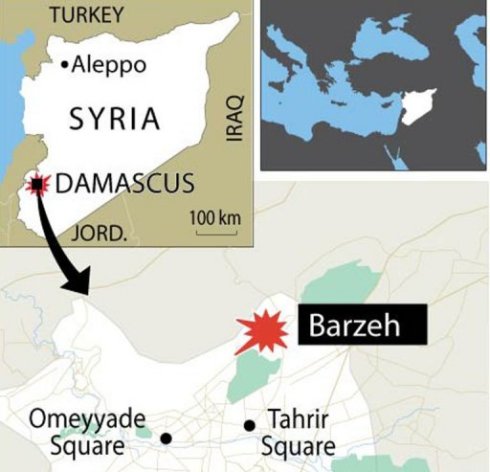
"Dozens of tortured bodies have been found in a flashpoint district of Damascus, a watchdog reported on Monday, in one of the worst atrocities in Syria's 21-month conflict. The report from the Syrian Observatory for Human Rights came as a gruesome video emerged on the Internet of a separate slaying of three children who had their throats slashed, also in the capital. 'Thirty bodies were found in the Barzeh district. They bore signs of torture and have so far not been identified,' said the Britain-based Observatory. The Syrian Revolution General Commission, a grassroots network of anti-regime activists, estimated there were 50 bodies, and added that 'their heads were cut and disfigured to the point that it was no longer possible to identify' them. The video posted online by activists showed the bodies of three young boys with their throats slit open and hands bound behind their backs. Their bodies were discovered on Monday in Jubar. The Observatory also reported the killing of the boys, who opposition activists said had been kidnapped the day before at a checkpoint on their way home from school. These reports could not be verified independently because of media restrictions by the Syrian authorities. Regime warplanes, meanwhile, bombarded rebel positions on the northeastern and southwestern outskirts of Damascus, leaving eight civilians dead including two children, said the Observatory. [...]"
[n.b. When you read "dozens of tortured bodies," translate as follows: "dozens of tortured males." Can you imagine dozens of murdered females being described in this fashion?]

Sunday, December 30, 2012

Nigeria

In Nigeria, Trapped between Islamist Radicals and Security Forces
By Sudarsan Raghavan
The Washington Post, December 30, 2012
"The armed men dragged Musa Muhammad out of his house and ordered him to lie face down on the ground. Then they grabbed his son. After asking his name, the men issued their judgment. 'I heard three gunshots -- pop, pop, pop,' Muhammad recalled, his voice trembling, his fingers in the shape of a pistol. 'My son was dead, killed in front of me.' His assailants were not the radical Islamists who have brutalized this town. They were government security forces sent to protect the residents. In the epicenter of one of Africa's most violent religious extremist movements, civilians are caught in a guerrilla conflict that has shattered families and communal relationships. The Boko Haram, a homegrown group with suspected ties to al-Qaeda, is assassinating people nearly every day, targeting Christians, soldiers, police, even astrologers as it seeks to weaken the Western-allied government and install Islamic sharia law in this nation. But the security forces have also carried out extrajudicial killings, imprisoned hundreds on flimsy grounds, looted and burned shops and houses, according to victims, local officials and human rights activists. ... 'In a guerrilla war, you need the help of the local population. But the security forces are alienating the people,' said Muhammad Abdullahi, the provincial director of religious affairs. 'They are making their jobs more difficult for themselves.'

Friday, December 28, 2012

"Honor" Killings / India

"It is difficult to get the actual number of 'honour killings', as they are often disguised as accidents or suicides." (EPA)
"Honour Killings" Bring Dishonour to India
By Chaitra Arjunpuri
Aljazeera.com, December 27, 2012
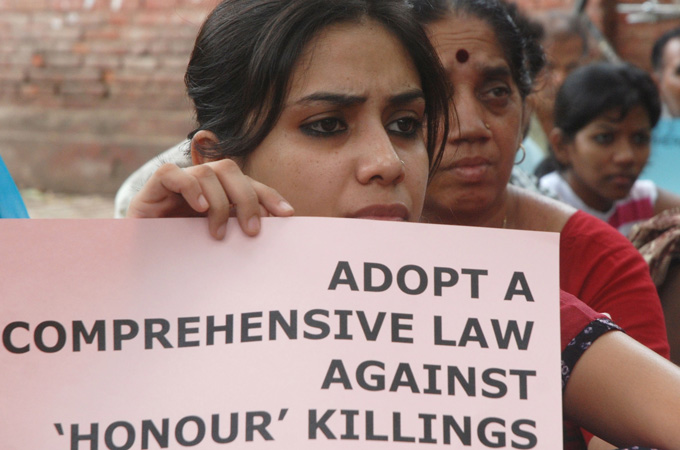
"The policeman jumped to his feet as the man walked into the station and placed the head of his sister, along with the butcher knife that decapitated her, on the table in front of him.  The incident in Kolkata on December 7 was another killing in the name of 'honour' and there has been a surge in such attacks over the past several months. Nilofar Bibi, 22, was only 14 years old when she left home in an arranged marriage. Alleging torture carried out by her in-laws, Bibi returned to her parents on November 28, but vanished days later. Her brother, Mehtab Alam, 29, had discovered his sister was living with an old boyfriend, Firoz, an auto-rickshaw driver. Alam stormed into the home and dragged Bibi onto the street in broad daylight. Passers-by looked on in horror as he cut off Bibi's head while saying 'she had sinned and had to be punished'. Alam left his sister's body in a pool of blood on the road, and calmly walked to the police station, her head in hand, to surrender himself. The siblings' family expressed support for Alam, saying they were proud he upheld their honour. In a country currently caught up in collective outrage over a gang rape of a medical student in New Delhi, Bibi's killing registered only a passing reference in the national media. But the coverage -- or the lack of it -- failed to hide the true extent of a scourge that bedevils many Indian women.

Saturday, December 22, 2012

Pakistan

"Many members of the Hazara Shiite community killed by Sunni extremists are buried in a graveyard in Quetta, Pakistan." (Declan Walsh/The New York Times)
Pakistan Reels With Violence Against Shiites
By Declan Walsh
The New York Times, December 3, 2012
"Calligraphers linger at the gates of an ancient graveyard in this brooding city in western Pakistan, charged with a macabre and increasingly in-demand task: inscribing the tombstones of the latest victims of the sectarian death squads that openly roam these streets. For at least a year now, Sunni extremist gunmen have been methodically attacking members of the Hazara community, a Persian-speaking Shiite minority that emigrated here from Afghanistan more than a century ago. The killers strike with chilling abandon, apparently fearless of the law: shop owners are gunned down at their counters, students as they play cricket, pilgrims dragged from buses and executed on the roadside. The latest victim, a mechanic named Hussain Ali, was killed Wednesday, shot inside his workshop. He joined the list of more than 100 Hazaras who have been killed this year, many in broad daylight. As often as not, the gunmen do not even bother to cover their faces. The bloodshed is part of a wider surge in sectarian violence across Pakistan in which at least 375 Shiites have died this year -- the worst toll since the 1990s, human rights workers say. But as their graveyard fills, Hazaras say the mystery lies not in the identity of their attackers, who are well known, but in a simpler question: why the Pakistani state cannot -- or will not -- protect them. 'After every killing, there are no arrests,' said Muzaffar Ali Changezi, a retired Hazara engineer. 'So if the government is not supporting these killers, it must be at least protecting them. That’s the only way to explain how they operate so openly.'